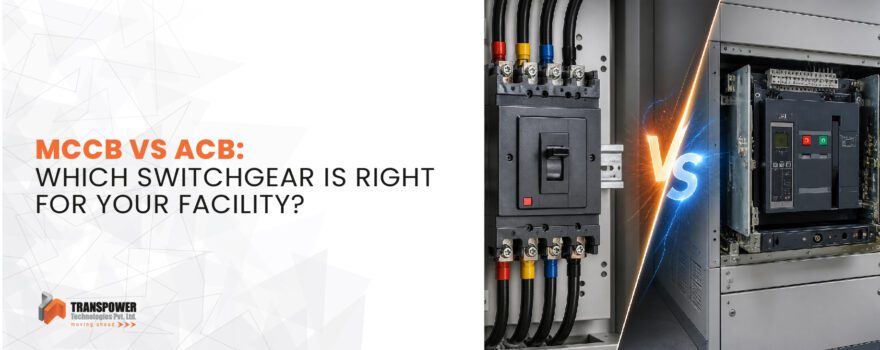
The selection of the proper switchgear is very important for the safety, reliability, and efficient operation of any facility. Some of the most frequently used protective devices include MCCBs (Molded Case Circuit Breakers) and ACBs (Air Circuit Breakers). Both these devices are used to protect electrical circuits from short circuits and overloads. However, there are some differences between the two. Understanding the difference can help you choose the appropriate type of switchgear for your needs.
What is an MCCB?
An MCCB, or Molded Case Circuit Breaker, refers to a small circuit breaker encased within a housing enclosure. The function of the MCCB is to safeguard the electrical circuit against short circuits and overcurrents.
The rated current capacity for an MCCB ranges from 100A to 2500A. It also features adjustable trip settings, which allow users to configure their protection settings according to the system’s needs. Its small size enables easy installation, and its low maintenance requirement makes it economically efficient for most establishments.
What is an ACB?
The ACB stands for an air circuit breaker, which is a high-performance circuit breaker suitable for high-current operations. This circuit breaker uses air as the arc quenching medium. An air circuit breaker is normally mounted in low voltage installations but with high current ratings, normally exceeding 800 Ampere, and can even be up to 10,000 Ampere or more.
The air circuit breakers are normally applied in main distribution switchboards in industrial and commercial installations. They provide superior performance with respect to fault detection and communication ability.
Key Differences Between MCCB and ACB
Current Rating & Capacity: MCCBs are suitable for lower current ratings, typically up to 2500A. In contrast, ACBs are designed for high current applications and can handle significantly larger loads, making them ideal for main power distribution.
Application Area: The MCCB is frequently used in branch circuits, small distribution boards, and equipment protection. On the contrary, the ACB is applied in the main incoming panel and important power distribution installations where a high level of reliability is required.
Breaking Capacity: ACBs have a higher breaking capacity compared to MCCBs, meaning they can safely interrupt larger fault currents without damage. This makes ACBs more suitable for heavy industrial environments.
Maintenance & Cost: MCCBs require minimal maintenance and are generally more affordable. ACBs, while more expensive, offer advanced features and require periodic maintenance to ensure optimal performance.
Features & Technology: ACBs have built-in protective devices, digital control, and communications capabilities, enabling their use within automation systems. On the other hand, MCCBs provide basic protection features, although they are being manufactured with electronic trip devices nowadays.
Which One Should You Choose?
Whether to choose an MCCB or an ACB will depend on your requirements and how complex the installation will be. An MCCB would be suitable if your installation has lower power needs, restricted space, and budget constraints. On the other hand, if you are operating a large industrial plant that requires advanced control, then ACB is the right choice for you.
In some instances, you may require both components in a system, whereby the ACBs work in the primary distribution system while the MCCBs work in the secondary distribution system.
Conclusion
Both MCCBs and ACBs are very important for protecting electrical installations, although their application varies depending on the size of the circuit breaker and its function within the system. By making the proper choice of switchgear, you will ensure that your system is safe, reliable, and efficient. For professional assistance in selecting the ideal switchgear for your electrical installation, visit Transpower Technologies.