When one speaks about the equipment of industries, especially when it comes to mechanical devices, one cannot fail to mention such terms as gearbox and motor. They have totally different functions, which means that it is vital to know the difference between the two.
What is a Motor?
The motor is an electrical machine which transforms electrical energy into mechanical energy. It produces movements, usually rotations. Motors are found everywhere – from factories to homes, and are the principal driving force in all mechanical systems.
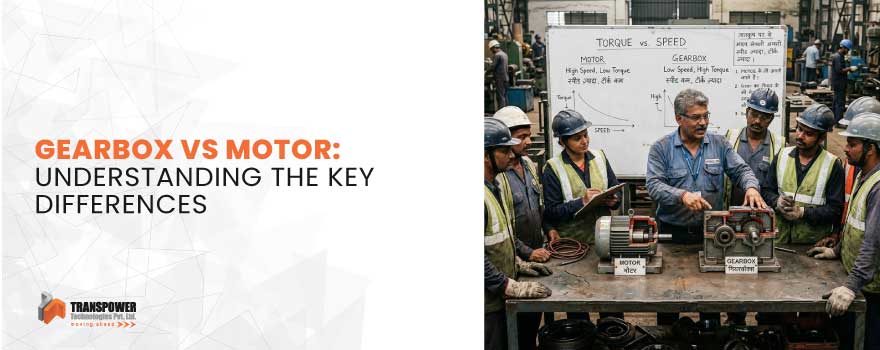
There are different kinds of motors – AC motors, DC motors, and Servo motors, among others. The fundamental job of a motor is the production of speed and torque; however, sometimes the speed produced by the motor may not be enough for its application, and here comes the gearbox into action.
What is a Gearbox?
A gearbox or gear reducer refers to a machine or system that is used in order to regulate the speed of the motor as well as its torque. Gearbox contains gears whose purpose is to change the input speed to the desired output.
The gearbox plays a very important role when there is a need for torque and controlled speed. Speed reduction results in increased torque, which makes the gearbox suitable for applications such as conveyor belts, crushers, and machinery.
Key Differences Between Gearbox and Motor
1. Functionality
The first major point of divergence pertains to the functionality. Motors produce mechanical work by transforming electrical energy, whereas gearboxes alter the mechanical action according to requirements.
2. Part played in the Machine System
Motors are responsible for the power input, whereas gearboxes serve as controls in the system. No motion can be produced without motors, whereas motion generated in the absence of gearboxes may prove inefficient and unsuitable.
3. Motion Speed and Force
Typically, motors are designed for fast operation and may lack torque in many cases for heavy-duty operations. However, the use of gearboxes ensures speed reduction and increased torque force.
4. Construction Elements
Motors feature an electrical design with rotors, windings, and stators. Gearboxes are built from mechanical parts that include gears, shafts, and bearings.
5. Applications
Motors find use in any sector where there is a need for movement of some kind. On the other hand, gearboxes are employed only in machines and operations where controlled motion is needed.
Why Are They Used Together?
In almost all industrial configurations, the combination of motors and gearboxes is employed in order to ensure efficiency in their operation. Motors supply the required energy, while gearboxes enable delivery of such energy at the desired speed and torque levels.
An illustration of this concept would be in a conveyor configuration whereby a motor alone operates at too high a speed for its proper utilization. The introduction of gearboxes lowers speeds and increases torques.
Choosing the Right Combination
The selection of proper motors and gears is dependent on several considerations, such as load requirement, speed, torque, and type of application. Besides efficiency, the proper selection of motors and gears leads to enhanced equipment longevity and lower maintenance costs.
The selection of a suitable gearbox depends on the ratio, power requirement, and working conditions. Just like the case of gearboxes, the selection of motors is based on speed and voltage.
Conclusion
It is important to be familiar with the difference between the two to help you understand how to properly operate them when used within an industrial process or mechanical system.
When you need the best gearbox or motor services, you can rely on Transpower Technologies. We provide the highest-quality products to suit your industrial applications.