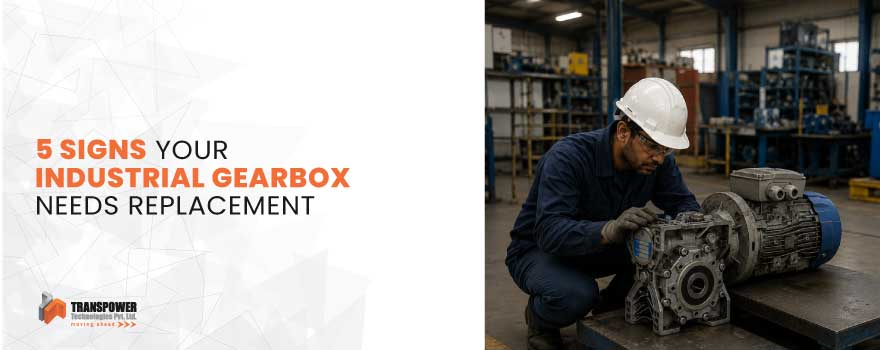
When a gearbox in an industry is noisy, vibrating, overheated, leaking oil, or malfunctioning repeatedly even after adequate maintenance, it is time for the gearbox to be replaced. When an industry has conveyors, mixers, pumps, compressors, or other motor driven equipment, this will help in avoiding unplanned maintenance of the motor and driven equipment.
Why Industrial Gearbox Condition Matters
The role of an industrial gearbox is to transmit power from the motor to the driven machinery. Sometimes a minor defect inside the gearbox might have adverse impacts on the overall drive train.
Transpower Technologies offers different types of industrial gearboxes which are used in Gujarat’s chemical industry, pharmaceutical industry, textile industry, cement industry, and manufacturing units. The list of our gearboxes includes the following: Rotomotive gearboxes, helical gearboxes, worm gearboxes, helical-worm gearboxes, and bevel-helical gearboxes with ratios from 5:1 to 1000:1.
It all comes down to the right time to maintain or replace the equipment.
5 Signs Your Industrial Gearbox Needs Replacement
Excessive Noise That Does Not Go Away
There will always be a certain amount of operating noise, but a sudden shift in noise level should never be disregarded.
A grinding, whining, knocking, or constant clicking noise might mean that gears are worn, bearing damage has occurred, gears are incorrectly meshed, or something inside has been damaged. If lubrication is okay and the noise persists following maintenance, then this might be a sign that the operating life of the gearbox is at an end.
As an instance, a conveyor gearbox which has started producing a constant grinding noise during operation needs checking to prevent spreading of this problem to the motor coupling and conveyor drive.
Gearbox Overheating During Normal Operation
Temperature is also a good parameter to consider when assessing gearbox health.
A gearbox that always runs at a temperature level higher than its standard operating condition indicates high friction, bearing wear, inadequate lubrication, wrong oil viscosity, overloading, or gear damage inside the gearbox. The process of overheating further leads to the deterioration of lubricants, thus leading to more heat generation due to high friction.
What is crucial here is the word “always”. If the gearbox overheats because of temporary overload of the machinery it works with, then this is a quite different scenario.
If all parameters of lubrication, ventilation, alignment, and loading have been assessed, and the gearbox still overheats, then it must be replaced.
Repeated Oil Leakage
Sometimes oil leakage can be fixed by changing the seal or gasket, but continuous oil leakage is not.
Gearbox oil is needed to ensure that the gears and bearings function properly. As leakage continues, there will be a loss of lubricant level in the gearbox, which leads to higher levels of friction and increased wear inside the gearbox.
Check the shaft seals, housing joint, and other areas for continuous oil leakage. In some cases, leakage is fixed by replacing the seals, thus, avoiding the need for complete gearbox replacement. However, when oil leakage is followed by unusual sounds, overheating, or housing surface damage, repair of only one component cannot prevent a future failure.
In the case of production equipment, leakage should be considered as a condition monitoring alarm.
Increasing Vibration and Shaft Movement
High vibration is among the clearest signs of a problem in a rotating drive system.
Gearbox vibration may be caused by such problems as worn bearings, damaged gears, shaft damage, misalignment, loose installation, or improper operating condition. The cause needs to be identified before it is decided whether gearbox replacement is required.
Condition monitoring will help at this point. If the vibration level rises despite proper alignment and installation, then some internal gearbox problem is likely developing.
Gearbox mounted to a high-duty conveyor or mixer should not be permitted to run until it fails merely because it is still rotating. Sudden gearbox failure will shut down the production process and can damage the motor and the coupling, too.
Frequent Breakdowns and Rising Repair Costs
However, the most powerful signal for replacement may not be an isolated and dramatic symptom. It may be the repair record.
When the same gearbox needs several repairs involving bearings, seals, lubrication, or gears, the total cost of such repairs may soon reach a level where it will become more profitable to buy a new unit.
Take, for example, a gearbox that has been failing several times within a year. Such repairs seem to be cheap individually, but their cost should include labor costs, materials, downtime and the possibility of another failure.
In that case, a new gearbox with appropriate torque, speed, ratio, installation method and service requirements will be a more rational choice.
When Should You Repair an Industrial Gearbox Instead?
Replacing a gearbox is not necessarily the solution whenever a gearbox breaks down.
A gearbox with a leaking seal, polluted oil or bearings problems might not necessarily require replacement. However, if the gearbox has been extensively damaged or has undergone many problems in the past, then replacement may become the more logical thing to do.
Replacement depends on how old the gearbox is, the number of hours it has been working, the load it carries and other such factors.
If a production line runs around the clock in a factory in Gujarat manufacturing chemicals or medicines, then replacement might be the more logical thing to do.
Choosing the Right Replacement Gearbox
Replacing a gearbox does not only involve finding another gearbox of similar motor ratings.
The new gearbox must be compatible with the application in terms of its input and output speeds, the needed torque, gear ratio, duty cycle, mounting system, and environment. The machinery to be driven by the gearbox must also be considered since a conveyor, mixer, and a pump can have varying needs in torque and operating conditions.
Transpower Technologies provides several types of industrial gearboxes like helical, worm, helical-worm, and bevel-helical gearboxes. The right type is determined based on the necessary speed reduction, torque transfer, mounting system, and application.
A right angle drive application may need a bevel-helical gearbox while a compact application with other self-locking needs will require a worm gearbox.
Gearbox Replacement vs Repair: What Should You Choose?
| Condition | Repair May Be Suitable | Replacement May Be Better |
| Minor oil leakage | Seal or gasket replacement | Repeated leakage with housing damage |
| Bearing wear | Bearing replacement | Extensive internal damage |
| Abnormal noise | Lubrication/alignment check | Persistent gear or bearing damage |
| Overheating | Correct load/lubrication | Persistent overheating after corrective action |
| Vibration | Alignment and mounting correction | Increasing vibration from internal damage |
| Repeated failures | Isolated repair | Frequent breakdowns and rising costs |
| Gear damage | Minor wear | Severe or multiple damaged gears |
| Housing | No structural damage | Cracked or severely worn housing |
The right decision depends on the actual condition of the gearbox rather than simply its age.
How to Prevent Premature Gearbox Replacement
Operating in a good way can prevent many unnecessary gearbox failures. Lubrication is among the first places to be checked for this purpose. Using the recommended lubricant and keeping the right oil level can prevent gear and bearing failure.
Gear alignment is another issue that must be considered by operators. Misalignment of motor to gearbox, or gearbox to the machine creates extra load on gears and bearings.
The operators must pay attention to unusual noises, vibrations, temperatures and leakage rather than wait until total failure happens. An ordinary maintenance chart indicating operating temperatures, lubricant changes and any recurring failures can help engineers diagnose problems before creating an emergency situation in production.
Why Work With an Experienced Industrial Gearbox Supplier?
Choice of gearbox is an engineering activity and not just a purchasing process.
Transpower Technologies is an organization with 70+ years of experience in providing industrial electrical and electromechanical products from its manufacturing facility at Makarpura GIDC, Vadodara. The organization caters to various industrial requirements including chemical, pharmaceutical, textile, cement, paper, food-processing and others from Gujarat, having 8,000+ customers and 10,000+ SKU’s across the product portfolio.
We provide a range of gearbox products including rotomotive gearbox, helical gearbox, worm gearbox, helical-worm gearbox and bevel-helical gearbox enabling the engineer to choose the gearbox according to the machine requirement and not just as a replacement.
For similar products, you may also browse our range of industrial motors and industrial gearboxes.
Bottom Line
A gearbox must not necessarily be replaced if it has been working for some years. Noise, heating up, oil leakage, vibration, and frequent failures are some more serious signs which signify that there is a need for an evaluation of the gearbox. In case if the expenses of repairing increase and production is being at risk, there must be a right choice of the replacement gearbox.
If you need help with industrial gearbox selection for industries in Vadodara and Gujarat, you may contact Transpower Technologies.