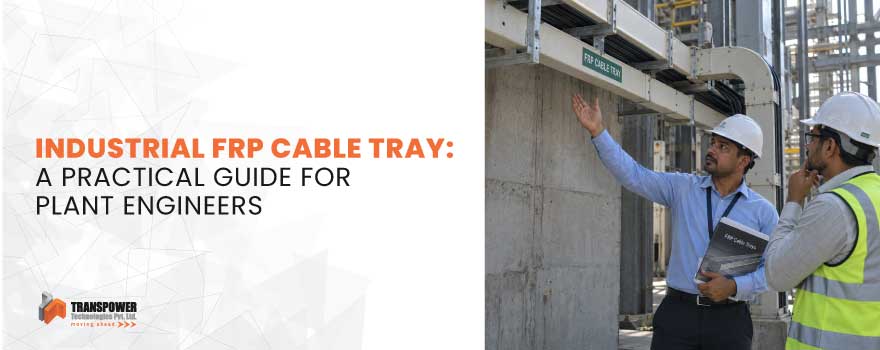
FRP cable trays are ideal in industrial plants where corrosion, moisture, chemical resistance, and durability are of great concern. Unlike traditional metal cable trays, FRP cable trays are fabricated using fiberglass reinforced plastic that makes them durable, resistant to corrosion, and appropriate for harsh industrial applications such as chemical, pharmaceutical, textile, and water treatment plants.
Choosing the correct cable tray in industrial plants cannot be an easy task, as one has to take into account various factors. It involves matching the cable trays to cable type, loading, installation area, ventilation, space availability, among other issues. Failure to consider these aspects may lead to damaging the cables.
What Is an Industrial FRP Cable Tray?
The industrial FRP cable tray is a system that acts as a pathway for the various cables used in industry and which are made of fiberglass-reinforced plastic.
Fiber Reinforced Plastic can be abbreviated as FRP. The fiber is what gives strength to the material, while the plastic gives resistance against moisture and corrosion.
This makes the FRP very useful in places where the standard metal cable trays might have been subjected to rust and corrosion problems.
At Transpower Technologies, we manufacture FRP cable trays in ladder style and perforated style, with different sizes ranging from 50mm to 600mm wide and any length as per project needs.
Why Do Industrial Plants Use FRP Cable Trays?
The major factor is the environment.
Cable trays installed in a clean electrical room will have totally different requirements compared to those installed in an area close to the processing chemicals. In Gujarat, where there are industries, cable trays can be subjected to humidity, corrosive chemical gases, washing down, etc.
FRP has greater resistance to these environments compared to metallic materials.
Corrosion Resistance
FRP will never corrode as does carbon steel. This is particularly helpful near chemical processing facilities, wastewater treatment plants, fertilizers plants, and many other places where corrosives can have an effect on metal parts.
This may minimize the need for maintenance throughout the lifetime of the facility.
Lightweight Construction
Installation of FRP cable trays is made easier than many types of steel cable trays. This is particularly true during installation processes where there is need for lifting of the tray to high elevations.
Reduced handling weights may even result in increased speeds of installation in well-designed cases.
Electrical Insulation
It does not conduct electricity. This property may be helpful when the electrical isolation of the tray assembly is needed.
Nevertheless, it cannot automatically be viewed as a replacement for the earthing/bonding provisions that should have been made for this particular project. The whole cable management system should meet the relevant electrical regulations.
Low Maintenance
Metallic trays that have been exposed to moist air and corrosive chemicals might need to be coated, inspected, and even replaced.
FRP does not corrode like traditional metals do, so it could be ideal for facilities where maintenance is difficult and expensive.
Ladder Type vs Perforated FRP Cable Tray
One of the first decisions a plant engineer needs to make is the tray design.
Transpower Technologies supplies both ladder-type and perforated FRP cable trays, but the two designs serve different installation requirements.
| Feature | Ladder Type FRP Cable Tray | Perforated FRP Cable Tray |
| Basic construction | Side rails with cross members | Solid base with perforations |
| Typical application | Heavy cable bundles | Light to medium cable arrangements |
| Ventilation | Excellent | Good |
| Cable installation | Easy for larger cable bundles | Convenient for organized cable routing |
| Heat dissipation | Very good due to open design | Good |
| Suitable cables | Power and larger industrial cables | Control, instrumentation and general cables |
| Maintenance access | Easy | Easy |
| Best suited for | Heavy-duty cable routes | General industrial cable management |
When Should You Choose a Ladder Type Tray?
Ladder tray is usually preferred in case of large or heavy cable bundles being installed.
Open construction facilitates air circulation around the cable. This feature is advantageous in installations of power cables, where the heat emission is an important factor to consider.
Moreover, it is easy to install and inspect the cables due to the open design of ladder tray that allows accessing the cables.
When Is a Perforated FRP Tray Better?
Perforated tray systems come in handy if continuous support of cables is required in the path while providing ventilation from the openings.
They are often used in control and instrumentation cables as well as light to medium cables.
In addition, the perforated base gives greater support for each individual cable in comparison to the ladder system.
How to Select the Right FRP Cable Tray for a Plant
There is no single FRP tray that works for every installation.
Before placing an order, plant engineers should look at several factors.
Calculate the Cable Load
Consider the cables first.
Establish the quantity of cables, the weights of each, cable diameter size, and if future expansion of the installation is possible. A tray that seems fit now could easily become crowded once the installation expands due to a company expansion.
You should never select the tray width by just measuring all the current cables together. Make provision for the proper installation and spacing of the cables in your plans.
Select the Correct Tray Width
The FRP cable tray offered by Transpower has various sizes ranging from 50 mm to 600 mm. There are various options available to the engineers for choosing the proper one for routing cables through them.
For instance, one can use a smaller cable tray for control cables and larger trays for power cables. It is based on the requirement and not the other way around.
Check the Support Arrangement
A sturdy tray is just one element of the installation.
Spacing, the span between support points, the installation method, loading of the tray, and the orientation are all factors in the resulting system.
Engineers should adhere to the manufacturers’ recommended spacing and engineering calculations rather than assuming the same configuration is suitable for any size of tray or cable load.
Common Mistakes Engineers Should Avoid
The cable tray may be technically excellent but will not work out as a project solution due to wrong selection or installation.
First, there is the issue of selecting the cable tray according to the width only. The weight of the cable and the distance of support are also important factors.
There is also the problem of failing to foresee future expansion plans. The industrial plant will eventually undergo some changes, including installation of new equipment, which will need extra cables. There will be no problems if enough space is provided in the initial stage.
Finally, engineers must avoid treating FRP as a universal solution. If the project involves very high temperatures, unusual chemical treatment, or mechanical shock, another type of material or a specially selected FRP may be required.
Always check the technical data of the manufacturer according to your project.
Why FRP Cable Tray Makes Sense for Gujarat Industries?
The state of Gujarat has a lot of chemical, pharmaceutical, engineering, textile, fertilizer, and manufacturing plants. The industrial regions of Vadodara, Makarpura GIDC, Ankleshwar, Bharuch, Ahmedabad, and other GIDCs are places that pose a challenge to electrical installation.
For such situations, cable management should not only serve as a mechanical structure.
A cable tray should be able to endure its surroundings and ensure that cables are neatly organized and easily accessed for maintenance purposes. FRP could serve as an excellent solution in such cases because of its ability to resist corrosion, be light in weight, and be low maintenance.
Why Choose Transpower Technologies for FRP Cable Trays?
Transpower Technologies has been catering to the industrial needs of Gujarat for more than 70 years, providing electrical and electro-mechanical products to various industries like chemical, pharmaceutical, textile, cement, and others.
Our FRP cable tray products comprise both ladder and perforated types with sizes ranging from 50 mm to 600 mm wide and customized lengths according to need.
We do not see cable trays in isolation; right selection depends upon the nature of the cable, load, routing, environmental conditions, support system, and expandability.
Our experts can assist in choosing the right FRP cable tray solution as per your engineering or procurement needs.
Please refer to our FRP Cable Trays range or contact the Transpower Technologies team for more details.
Bottom Line
The ideal FRP cable tray for a plant is not one that is simply the biggest or the most robust of all.
FRP may be a practical alternative to the use of metal in a conventional cable management system in environments that are highly corrosive and include plants for chemicals, pharmaceuticals, water treatment, etc. in Gujarat.
Looking for assistance in selecting the best FRP cable tray for your plant? Have a look at the Transpower Technologies FRP Cable Tray range.