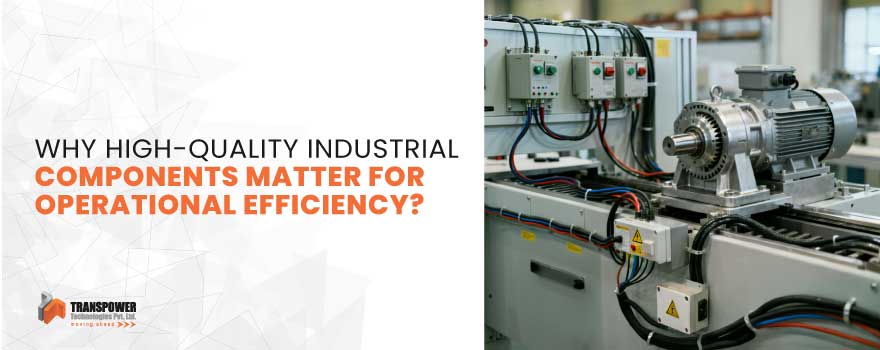
In today’s competitive industrial landscape, operational efficiency is not just a buzzword – it is a strategic necessity. Businesses involved in manufacturing, automation and heavy industry are constantly looking for ways to optimize their operations, reduce costs and increase reliability. One of the most impactful decisions they can make is to choose high-quality industrial components. From reducing downtime to increasing productivity and safety, the quality of components used in machinery and systems plays a vital role in overall operational performance.
Reducing Downtime and Its High Costs
Industrial operations depend on reliable and continuously running machines. When a component fails prematurely, it can cause unplanned downtime – an interruption that halts production and causes significant financial losses. According to industry statistics, unplanned downtime can cost industrial manufacturers up to $50 billion annually, with the average facility losing hundreds of production hours each year due to equipment failure.
High quality components are engineered to withstand tough operating conditions, dramatically reducing the frequency of failures. Fewer breakdowns mean fewer interruptions, smoother production flow and more predictable output. By investing in quality upfront, organizations can avoid extensive costs associated with unplanned interruptions – such as premium repair labor, rushed parts orders, idle workforce hours and delayed deliveries.
Enhancing Overall Equipment Effectiveness
Operational efficiency in manufacturing is often measured by overall equipment effectiveness (OEE) – an overall metric that evaluates what portion of planned production time is actually productive. OEE takes into account three key factors: availability (uptime), performance (production speed), and quality (defect-free output).
Availability: Reduced machine failures increase uptime.
Performance: Precise and well-engineered components help machines operate consistently at optimal speed.
Quality: Reliable parts help maintain precision, leading to fewer defects and less waste.
Improving Durability and Longevity
The primary benefit of premium components is increased durability. Quality industrial parts are manufactured using superior materials and undergo more rigorous testing than cheaper alternatives. This means they can tolerate extreme temperatures, heavy mechanical stress, vibration and corrosive environments without failing prematurely.
In practical terms, this translates to longer maintenance intervals and extended service life for machinery. When components last longer, spare parts inventory costs are reduced, maintenance schedules are simplified, and predictability is increased – all of which contribute to lower long-term operating costs.
Boosting Productivity and Throughput
Operational efficiency isn’t just about avoiding failures – it’s also about maximizing productivity. Higher-quality components often provide better precision, tighter tolerances, and better performance. For example, well-engineered bearings reduce energy-robbing friction, precision gears ensure power is delivered without loss, and advanced electronic sensors improve control and response.
These improvements allow machinery to run faster and more reliably without compromising accuracy or safety. In turn, this increases throughput and accelerates the ability to meet production targets, respond to customer demand, and operate at scale.
Cost Savings Over the Lifecycle
While higher-quality components may have a higher initial price, they often prove to be more cost-effective over the lifecycle of the equipment. Savings come in several forms:
Lower maintenance and repair expenses due to fewer failures.
Reduced inventory costs because parts last longer and fewer spares are needed.
Lower energy costs due to efficient operation and reduced friction/wear.
Minimized waste and rework due to improved precision and product consistency.
Enhancing Safety and Compliance
In industrial environments, equipment failure not only impacts productivity – it can also jeopardize worker safety and regulatory compliance. Poor quality components are more likely to malfunction under stress, creating risks such as mechanical failure, electrical failure, or process instability that can endanger personnel and lead to violations of safety standards.
High-quality components are typically manufactured to meet or exceed industry safety certifications and standards, providing confidence that the system will operate safely even under load.
Conclusion
In an era where industrial competitiveness is shaped by speed, reliability and cost management, choosing high quality industrial components is essential to achieve operational excellence. From reducing costly downtime and increasing productivity to improving safety and long-term cost efficiency, premium components make a measurable difference in the performance of industrial systems.
For operations looking for top-tier industrial components that deliver reliability, durability and peak performance, Transpower Technologies stands out as a reliable supplier. With a commitment to quality and a range of components designed to support the most demanding industrial environments, Transpower Technologies helps businesses achieve greater operational efficiency and maintain competitive advantage.