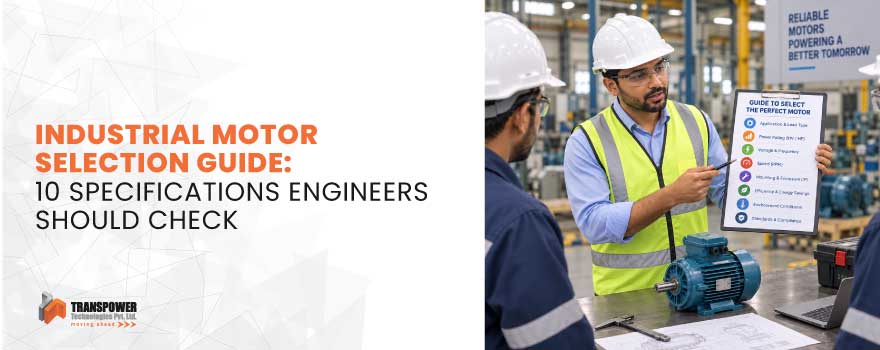
The selection of a motor is not only based on choosing the right HP. The engineers need to consider a minimum of 10 parameters which include the following: Power, RPS, Voltage, Efficiency, IP Ratings, Mounting style, Duty Type, Environment, Pole Count, and Application Requirements. The company Transpower Technologies provides motors manufactured by Siemens, Crompton Greaves, and Hindustan Electric Motors in Vadodara.
Why Industrial Motor Selection Requires More Than HP?
The motor could have the right 30 HP capacity and still not be right for the specific machinery. Wrong RPM would lead to slow manufacturing speed, wrong mounting configuration would cause difficulties during installation, and insufficient protection would cause problems in environments that are dusty, moist, or corrosive.
Motor selection must therefore begin with the driven equipment.
Pumps, compressors, conveyors, blowers, mixers, and fans have varying torque and starting needs. Transpower’s motors include Siemens, Crompton Greaves, and Hindustan Electric Motors and come in configurations like 415V, 50/60Hz frequency, 2/4/6/8 pole, S1/S4 duty, various mounting configurations, and IE2, IE3, and IE4 efficiencies.
10 Industrial Motor Specifications Engineers Should Check
Motor Power Rating: kW or HP
Motor power is the first specification that customers look into, but it is not the sole criterion.
The output of the motor has to be suitable for the mechanical load that will be placed on the motor. Overheating may occur when the motor is undersized and continuously loaded. When the load is well below the capacity of the motor, then the motor will be inefficient.
For instance, the mechanical load of a motor driving a centrifugal pump may vary from a conveyor that starts and stops several times within an hour.
Before choosing the motor, the following criteria need to be determined:
- Required output power
- Maximum mechanical load
- Starting load
- Load variation
- Operating hours
The aim is to select a motor that suits the application rather than having the maximum horsepower rating.
Motor Speed and RPM
The motor speed influences the speed and torque of the load being driven.
Typical configurations of industrial motors are 2, 4, 6, and 8 poles. If the frequency is 50 Hz, then such pole configurations relate to high, medium, and low speeds respectively; however, the operating RPM of the motors is slightly below the synchronous RPM due to the slip phenomenon.
Thus, a 2-pole motor is applied if higher speed is needed, and a 4-pole motor is usually used for many pumps, fans, compressors, and other industrial machines.
If there is a gearbox or VFD connection with the motor, then engineers have to consider the entire drive system rather than RPM alone.
Voltage and Frequency
The voltage and frequency should be compatible with the electrical supply to the factory and with the motor’s name plate specifications.
In Transpower, there are 415V motors from Siemens and Hindustan motors, which come with 50 Hz and 60 Hz.
Typically, for an Indian industrial factory, the supply is usually 415V, 3-phase, 50Hz. But always check the site supply before ordering.
When selecting motors for replacements, it will be better to cross-check the nameplate specifications of the motor and motor quotation specifications.
Efficiency Class: IE2, IE3 or IE4
Efficiency of the motor becomes more crucial in cases where the machinery works for extended periods of time.
There are different efficiency classes as per IEC which include IE1, IE2, IE3, and IE4 from standard efficiency to super-premium efficiency. According to BEE material, IE3 is rated as premium efficiency and IE4 as super-premium efficiency while mentioning IS 12615 for efficiency of three-phase induction motor.
In case of operation of a motor for 16 or 20 hours a day, an efficiency difference may affect the electricity bills for a period of years.
But it is recommended that engineers consider efficiency under the normal operating load conditions rather than choosing the motor on the basis of higher IE class.
Transpower provides Siemens, Crompton Greaves, and Hindustan motors with IE2, IE3, and IE4 categories as per product range.
IP Protection Rating
The rating of the motor IP represents how protected it is from dust or water penetration.
Industrial motors can be available in protection classes such as IP55, IP56, and IP65. Transpower offers the protection ratings for its Siemens, Crompton, and Hindustan motors.
The right protection class will depend on the installation environment.
For instance, an indoor clean manufacturing facility may need a different protection rating compared to a chemical plant that involves moisture or dust.
Mounting Arrangement
Compatibility mechanically is equally significant as it is electrically.
The types of industrial motors include foot mounting, flange mounting, and foot cum flange mounting. The Siemens, Crompton Greaves, and Hindustan motor ranges from Transpower offer different types of mounting.
For example, ordering a foot-mounted motor when the existing machine requires a flange-mounted arrangement can create unnecessary modification work at the installation stage.
Duty Type
S1 relates to continuous running, while S4 refers to intermittent running where the period includes starting, running, and resting cycles. Transpower’s motor specification list features the S1 and S4 duty types.
The above specification is critical in cases where there are repeated stopping and starting of machines.
A constantly running pump will have a totally different heat cycle compared to one used for conveying and lifting, which involves repeated start, acceleration, and stopping.
It is, therefore, advisable for the engineers to inform the suppliers about their operational data rather than thinking all motors for industries are equal in terms of duty cycle.
Number of Poles
The number of poles determines the speed of the motor.
For 50 Hz supply, 2-pole, 4-pole, 6-pole, and 8-pole motors are commonly employed at various speeds according to Transpower.
The relationship can be approximated as:
Synchronous speed = 120 × frequency / number of poles
Actual running speed will be somewhat lower because of slip.
The correct pole configuration should be selected based on the machine’s required speed, torque, gearbox ratio, and process conditions.
Cooling Method and Motor Construction
Industrial motors produce heat when working, hence cooling systems and construction play a big role in their performance.
Transpower gives information on housing made of cast iron and IC411 cooling system for Siemens, Crompton Greaves and Hindustan motor range.
Cast iron construction may be appropriate for tough industrial conditions where mechanical strength and durability are needed.
IC411 is a common form of cooling system used for industrial motors. However, engineers need to take into consideration ambient temperature, ventilation, clearance for installation and loading since cooling system works under the conditions of installation.
Application, Starting Torque and Operating Conditions
The final specification is the application itself.
A motor driving a pump does not necessarily have the same requirements as one driving a compressor, conveyor, mixer, crusher, or blower.
This information allows the supplier to recommend a motor that fits the complete mechanical and electrical system.
For hazardous areas, the motor should be selected according to the area’s classification and applicable equipment requirements. A standard industrial motor should not be assumed suitable simply because it has a high IP rating.
Why the Motor Supplier Matters
The rating of the motor IP represents how protected it is from dust or water penetration.
Industrial motors can be available in protection classes such as IP55, IP56, and IP65. Transpower offers the protection ratings for its Siemens, Crompton, and Hindustan motors.
The right protection class will depend on the installation environment.
For instance, an indoor clean manufacturing facility may need a different protection rating compared to a chemical plant that involves moisture or dust.
Common Motor Selection Mistakes
Most motor troubles start even before installation of the motor in the plant.
Selection of the motor solely based on horsepower is one common mistake that many make. Replacement of a motor without verifying the RPM, frame size, mounting style, duty, and IP protection are other common mistakes.
Oversizing of the motor is yet another common mistake that engineers do while selection of motors. Having a bigger motor does not mean that the performance will be improved. If the motor operates under light loads during most of its operation, there is no practical benefit from the extra capacity.
Engineers must avoid selecting a motor without taking the environment into account. A motor that can be used in a clean indoor environment cannot be used in the chemical process environment.
Choose the Right Industrial Motor for Your Application
Selection of an industrial motor must begin with its application rather than the brand or cost of the motor. Compatibility between power, speed, voltage, efficiency, IP rating, mounting, duty, number of poles, cooling, and environment is essential.
In Vadodara and other regions of Gujarat, Transpower Technologies offers industrial motors from Siemens, Crompton Greaves, and Hindustan Electric Motors, with over 70 years of experience in electro-mechanical industries.
Visit our industrial motor range page or get in touch with Transpower Technologies at Makarpura GIDC, Vadodara to help you choose an industrial motor depending on your application.
References
Bureau of Energy Efficiency (BEE) — energy-efficient motor classifications and industrial energy-efficiency guidance.