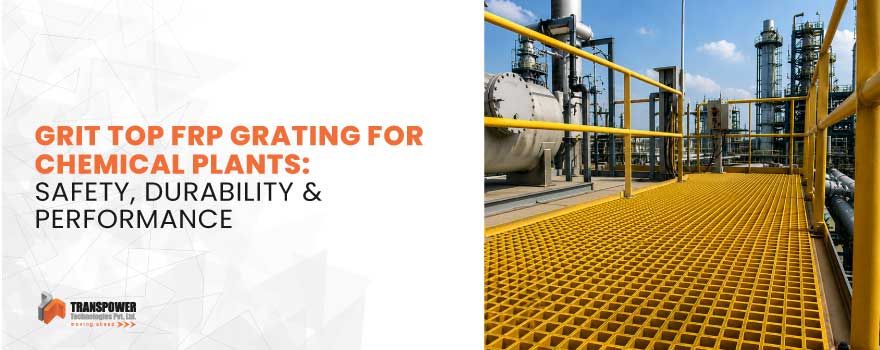
The Grit Top FRP Grating is ideal as a flooring material for chemical industries where non-slip properties, resistance to corrosion, and durability are important considerations. The abrasive grit top makes it easy to maintain good foot grip in situations where there are chemicals, water, and oil present, while the FRP nature of the grating helps in eliminating most of the issues of corrosion that affect traditional steel grating.
Why Grit Top FRP Grating Is Suitable for Chemical Plants?
Chemical plants provide some of the most challenging environments for industrial floors. Walkways, platforms, stair treads and operation areas will be exposed to acids, alkalies, solvents, moisture and chemical fumes. Steel floor surfaces will have to be checked and coated with protective materials in case of corrosion problems.
Grit Top FRP Grating is unique in its construction. The grating features fiberglass reinforced polymer core and a gritted non-slip surface which forms a walking platform for the industrial environment.
It is the surface that makes it unique.
As opposed to the smooth FRP grating, the Grit Top FRP Grating features an abrasive surface providing better traction under the feet. It is especially useful in process equipment area, chemical operations and places where water or oil make the floor slippery.
Grit Top FRP Grating Improves Industrial Safety
Safety has been considered as one of the most important factors when choosing Grit Top FRP Grating for use in a chemical plant. In addition, a wet or contaminated floor becomes a hazard to slipping near the pump area, tanks, pipes and other processing equipment.
The rough texture of the floor provides an extra friction between the shoes and the floor. This is beneficial especially in locations where the movement through wet and chemical areas is constant.
From the perspective of the plant engineer, the benefit of the flooring material can be directly seen by the safety factor incorporated in the floor itself. This can be utilized for the walkway, platform, stairs, maintenance platform and access platforms.
However, the use of grating should be carefully considered in terms of the actual operating condition.
Corrosion Resistance for Chemical Plant Environments
Maintenance for corrosion is an important consideration in chemical processing plants. Conventional metallic flooring is prone to corrosion when it is exposed to aggressive chemicals, moisture and corrosive environment especially when there is damage to coatings.
Grit Top FRP Grating is highly resistant to many corrosive environments since it does not depend on exposed steel for bearing the loads.
This makes Grit Top FRP Grating a good choice for application in locations where the conventional metal grating will need regular maintenance for coatings. Many chemical plants in the industrial belt of Gujarat especially those located at Vadodara, Bharuch and Ankleshwar function in an environment where the choice of material affects maintenance considerations.
However, FRP is not resistant to all chemicals. Selection of the resin system depends on the chemicals, concentration, exposure time and temperatures. It is therefore advisable to do a technical compatibility test before specification of the product in any process area.
Grit Top FRP Grating for Walkways and Platforms
In chemical facilities, there are many elevated and ground level access points where the stability of the footing is important. Grit Top FRP Grating may be installed in walkways, platforms, stair treads, and equipment access points in industrial applications.
The open grid design of the grating enables liquids to flow through the grating and not stay on top of the walking surface. This would be helpful in wash-down areas or wherever there is liquid exposure.
Maintenance personnel need good access. An FRP platform is an example of how a working surface could be provided around pumps, motors, valves and other equipment without adding additional corrosive materials to the environment.
Grit Top FRP Grating vs Conventional Steel Grating
The choice between FRP and steel depends on the plant environment, loading requirements and lifecycle priorities. Steel remains a strong option for applications requiring very high mechanical strength or extreme temperatures, but FRP can offer significant advantages where corrosion resistance and low maintenance are priorities.
| Feature | Grit Top FRP Grating | Steel Grating |
| Anti-slip surface | Abrasive grit surface | Depends on surface design |
| Corrosion resistance | High in suitable chemical environments | Requires protection against corrosion |
| Maintenance | Generally low | Coating and corrosion inspection may be required |
| Weight | Lightweight compared with many metallic alternatives | Generally heavier |
| Electrical conductivity | Non-conductive | Conductive |
| Chemical plant suitability | Strong option for many corrosive areas | Depends on coating and environment |
| Installation and handling | Easier handling due to lower weight | Heavier handling requirements |
The correct selection should not be based on price alone. Plant engineers should compare the initial cost, load capacity, chemical compatibility, installation requirements and expected maintenance over the service life.
Where Can Grit Top FRP Grating Be Used?
The Grit Top FRP grating can be selected for use in many different parts of a chemical or process plant. Common examples are: Operating Platforms; Walkways; Stair treads; Tank areas; Pump platforms; Maintenance Platforms.
There are also other industrial sites that would benefit from its use because of the presence of moisture or corrosive materials that can be found in such places like water treatment plants, wastewater areas, refineries, and petrochemical facilities.
One specific example of the use of this FRP grating is a maintenance platform around a chemical process pump wherein there could be water, oil, and chemical splashing.
Key Performance Factors Before Selecting Grit Top FRP Grating
Grating selection is more than just picking out the finish. Engineers should consider the load requirement, panel size, spacing, support conditions, resin systems, chemicals, and temperatures of operation.
The load requirement is especially crucial in such instances. Grating meant for pedestrian use alone might not be suitable in locations where there will be heavy equipment use.
Chemical resistance is yet another thing to look out for. One should ensure that the reinforcement resin systems are in tandem with the chemicals within the industrial plant instead of being satisfied with the phrase ‘chemical resistant’ of the FRP material.
Temperatures are also something else to look at. FRPs have certain temperature ranges in which they can be used, and locations of operation with temperatures beyond these ranges call for further engineering analysis.
Why Choose Grit Top FRP Grating from Transpower Technologies?
Transpower Technologies recognizes that industrial flooring is much more than just a building material, but an integral component of the plant’s safety and maintenance system. For over 70 years of industrial expertise, we have been providing manufacturing and process industries in Gujarat with products designed for harsh industrial environments.
Our wide selection of FRP gratings and FRP cable trays caters to the needs of the chemical, pharmaceutical, textile, cement and other industrial sectors. At Makarpura GIDC, Vadodara, we assist engineering and procurement experts in choosing products that match their real environmental conditions and not just their purchasing costs.
The right Grit Top FRP Grating for a chemical plant should be determined by the chemical environment, load bearing requirements, dimensions and installations among others.
Frequently Asked Questions
What is Grit Top FRP Grating?
Grit Top FRP Grating is a fiberglass-reinforced polymer grating manufactured with an abrasive grit surface for improved slip resistance. It is commonly considered for industrial walkways, platforms, stair treads and access areas where wet or contaminated surfaces may create slip hazards.
Is Grit Top FRP Grating suitable for chemical plants?
Yes, Grit Top FRP Grating can be suitable for many chemical plant environments because FRP provides corrosion resistance and the grit surface improves traction. The specific resin system must be checked against the chemicals, concentration and operating temperature involved.
What are the applications of Grit Top FRP Grating?
Common applications include chemical plant walkways, operating platforms, stair treads, pump platforms, tank access areas and maintenance platforms. It can also be used in wastewater, water treatment, petrochemical and other corrosive industrial environments.
Key Takeaway
Anti-skid Properties, Corrosion Resistance & Light Weight – These features make Grit Top FRP Grating suitable for many chemical plants for its walkway and platform area applications. The right specifications will depend on the loading, chemicals and temperatures. For all technical queries and FRP grating needs in Gujarat, get in touch with Transpower Technologies, Makarpura GIDC, Vadodara.
Know more about Transpower Technologies’ FRP Grating or connect with us for application based product recommendations.