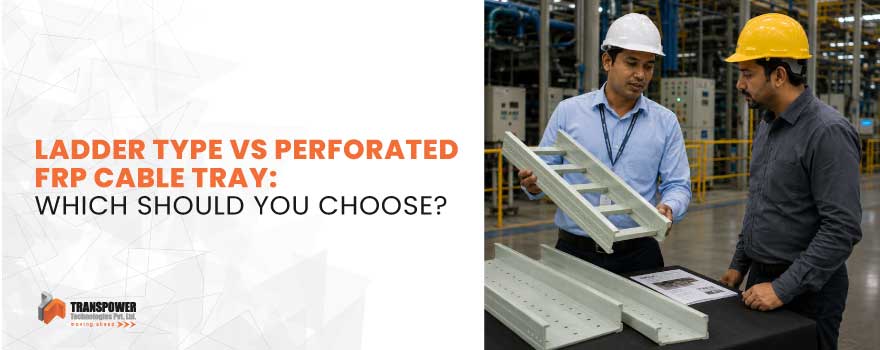
The decision between using a Ladder Type FRP Cable Tray and a Perforated FRP Cable Tray is determined by the load on your cable, the environment in which it is installed, and the ease of maintaining it. The ladder type FRP cable trays are suited for heavy power cables and ventilation while perforated FRP cable trays offer superior cable support and protection.
Cable management systems play an important role in safeguarding electrical assets for industries in chemical, pharmaceutical, textile, food processing, and water treatment industries. With our long-standing experience of over 70 years in supplying cable management systems to industries across Gujarat, Transpower Technologies has been helping engineers choose appropriate FRP cable trays.
Why FRP Cable Trays Have Become the Preferred Choice?
The industrial setting poses a lot of dangers to electrical wiring such as moisture, chemicals, dust, high temperature, and corrosive gases. The traditional steel trays used in these settings are likely to be painted, inspected, and replaced more often due to corrosion. FRP cable trays help in solving most of these problems because they do not rust; they withstand most chemicals in an industrial environment and stay strong even after years of exposure.
They are also light, which makes installation much easier. Being that FRP is not conductive, it provides additional safety in an industrial setting for electricity.
Understanding Ladder Type FRP Cable Trays
A Ladder Type FRP Cable Tray comprises of two longitudinally placed side rails, which are joined together through evenly spaced cross members forming an open grid pattern resembling a ladder. This particular type of cable tray design has gained wide acceptance in heavy industrial settings due to its high airflow capacity around cables.
The power cables generate heat throughout their operation. In the absence of adequate airflow, the cables heat up and can result in reduced lifespan of the insulation material of the cable. Due to the open design of ladder type cable tray, heat dissipation becomes easy, thus making it suitable for carrying heavy load power cables over long distances.
It also makes maintenance easier since the maintenance engineers can access the cables easily and change the cables whenever required without disassembling large portions of the cable tray.
Such type of FRP cable tray is found in chemical industries, cement manufacturing plants, power plants, water treatment industries, petrochemical plants, and many other such heavy industrial setups.
Understanding Perforated FRP Cable Trays
The perforated FRP cable tray consists of a solid bottom having perforations made at regular intervals, giving moderate air circulation along with continuous bottom support to the cables.
In contrast to ladder trays, perforated trays provide support to smaller cables across the length of the tray. Perforated trays are well-suited for instrumentation cables, automation, communication cables, PLCs, and control panels where management of cables is equally essential besides protection.
The solid bottom prevents sagging of cables and gives additional mechanical protection against any unintended impact on the cables during maintenance work. Also, perforations allow water drainage as well as give some amount of ventilation without compromising on neatness.
Perforated trays find wide application in pharmaceutical companies, food processing industries, electronics manufacturing industries, commercial buildings, and automation systems.
Ladder Type vs Perforated FRP Cable Tray: Key Differences
| Feature | Ladder Type FRP Cable Tray | Perforated FRP Cable Tray |
| Best For | Heavy power cables | Control & instrumentation cables |
| Ventilation | Excellent | Good |
| Heat Dissipation | Maximum | Moderate |
| Cable Support | Suitable for large cable bundles | Continuous cable support |
| Maintenance Access | Very easy | Easy |
| Cable Organization | Moderate | Excellent |
| Installation | Faster for heavy cables | Better for smaller cable layouts |
| Common Applications | Chemical plants, power plants, cement industries | Pharma, food processing, automation systems |
Which Cable Tray Performs Better in Industrial Environments?
It all depends on their specific functions and applications.
In case you have a project that requires the usage of heavy power distribution cables, then ladder type FRP cable trays will definitely perform well for you. The open design facilitates heat dissipation and easy cable expansion later on. Facilities with many motors, transformers, and switchgear panels as well as power distribution system will find these cable trays beneficial to use.
When the project entails the presence of sensitive control wiring, instrumentation, and communication cables, then perforated cable trays are the way to go. They help with keeping cable routing organized and minimize any cable damage that may occur during maintenance.
These days it has become common for many industrial facilities to use both types of cable trays. Power distribution cables can be placed in ladder trays, whereas instrumentation and control cables are placed in perforated trays.
Factors to Consider Before Selecting an FRP Cable Tray
Firstly, one should look at the type of cable used. Power cables give out much more heat compared to control cables, which makes ventilation a significant aspect when designing the system.
The installation environment must also be taken into account. Industries using acids, alkali, salty water, moisture or other corrosive substances demand material that will not degrade under continuous usage. FRP trays work perfectly well in these cases as they do not change their characteristics during many years of operation.
Expansion must also be taken into consideration. As electrical equipment develops, it needs additional cables to connect different elements of the system. It is easier to make such changes using ladder trays because additional cables can be easily installed there. Perforated trays are convenient when there is much wiring and it requires constant maintenance.
Why FRP Cable Trays Offer Better Long-Term Value
Even though galvanized steel cable trays have continued to be commonly used, many companies are adopting FRP due to its reduced lifecycle cost. Galvanized steel cable trays are susceptible to corrosion, particularly in chemical processing factories and coastal areas, which makes them expensive to maintain.
FRP cable trays hardly need maintenance and they will never corrode, and therefore there is no need for regular painting or anti-corrosion processes. The light weight of the FRP cable trays means that less time is spent during their installation.
In terms of companies looking for ways of cutting down maintenance costs, then FRP cable trays could be a better option.
Why Choose Transpower Technologies?
Being in the market for over 70 years, Transpower Technologies is among the well-known suppliers of industrial electrical equipment in Gujarat. We offer an array of services that include FRP Cable Trays, FRP Gratings, Siemens Switchgear, Industrial Motors, Gearboxes and Electrical Drive System for chemical, pharmaceutical, textile, food processing, engineering and manufacturing industries.
Our technical experts collaborate with engineers, consultants, EPC contractors and maintenance managers to provide them with appropriate solutions of cable management according to their needs and not the other way round.
Frequently Asked Questions
Which is better, ladder type or perforated cable tray?
Neither design is universally better. Ladder type cable trays are ideal for heavy power cables because they provide excellent ventilation and higher load capacity. Perforated cable trays are better suited for control, instrumentation, and communication cables that require continuous support.
Can ladder type cable trays be used indoors?
Yes. Ladder type FRP cable trays are suitable for both indoor and outdoor installations. They are commonly installed inside manufacturing facilities, utility buildings, and industrial plants where heavy power cables need efficient ventilation.
Why are FRP cable trays preferred in chemical industries?
Chemical industries frequently expose electrical systems to corrosive substances, moisture, and aggressive environments. FRP cable trays resist corrosion, require minimal maintenance, and offer a significantly longer service life than conventional steel cable trays.
Bottom Line
Both types of FRP Cable Tray, namely Ladder type and Perforated FRP Cable Tray, are equally effective solutions for cable management. Ladder type is the recommended option for power distribution due to its excellent ventilation and strength characteristics, while the perforated cable tray provides enhanced support and safety for control and instrumentation cables. Choosing the proper cable tray at the designing stage increases the level of safety, makes maintenance easier and prolongs the service life of your cable management systems.
If you are looking for a reliable cable tray solution for a new industrial facility or would like to upgrade your existing infrastructure, we can help you with it. Transpower Technologies has been helping our customers for more than 70 years in Gujarat, providing our clients with high-quality products and excellent technical assistance.